Thursday, September 6, 2018

MyMusingsSangSpeak- Pet Puja - Tondli Bhaat


Tondli Bhaat

Tondle or Tondli (Marathi) is Ivy Gourd in English, Tindora/Tendli in Hindi and it is a much sought-after seasonal vegetable in India, prepared in various ways across the country in combination with onions, tomatoes etc. Tondli Bhaat is a delicious Maharashtrian recipe, made with Tondli and rice; it used to be a must in the traditional Maharashtrian wedding spread. Things have changed with time and it is very rarely served in Maharashtrian weddings anymore. Tondli Bhaat is one of my favourite dishes, and here is the recipe for the same. One needs to use AmbaMohar rice variety for this recipe to get the desired taste.

Ingredients


Rice (AmbaMohar) – 1 cup
Tondli (Ivy Gourd) – 100 gm
Onion – 1 medium
Tomato – 1 small
Groundnuts – 1 tablespoon
Garlic Ginger Coriander paste – 2 teaspoons
Turmeric powder – ½ teaspoon
Garam Masala – ½ teaspoon
Kanda Lasun Masala – ½ teaspoon
Oil+Pure Ghee – 2 tablespoons
Cinnamon – 1 piece of 2 inch
Mustard seeds – ½ teaspoon
Bay leaf – 1 large
Curry leaves – 10-12 nos
Big cardamom – 2-3 nos
Black Pepper – 6-7 nos
Cloves – 4-5
Green Chillies – 1-2
Salt – as per taste
Water – 3 cups approximately
Grated coconut – 2 tablespoons
Chopped coriander leaves – 2 tablespoons
Cashewnuts – for garnish
Kishmish – for garnish

Method
Soak groundnuts in water for half hour. Wash all the vegetables, slice Tondli, onion and tomato lengthwise. Wash rice and set aside. Heat oil and ghee in a pan and cinnamon, cardamom, bay leaf, cloves, black pepper, curry leaves, mustard seeds and allow to splutter for a minute. Add sliced onions and fry till light brown. Add slit green chillies and sliced tondli and fry for another minute. Add washed rice, soaked groundnuts, ginger garlic coriander paste, turmeric powder, garam masala, kanda lasun masala, salt, sliced tomato and stir well for about 2-3 minutes. Add approximately 3 cups of water and bring to a boil, then cover and allow to cook for about 15 minutes. You can pressure cook also if you wish to. Add more water if required.
Serve Tondli Bhaat hot, topped with grated coconut, chopped coriander, fried cashews and kishmish along with pure ghee.

Note – Preparation time is approximately 45 minutes to one hour. This quantity serves about 4 people.

Sunday, August 12, 2018

MyMusingsSangSpeak- The Bench


The Bench
Benches- we come across them at so many places- homes, parks, gardens, schools, colleges, theatres and so on and each one of them signifies a certain stage of our growing up years and life in general. These benches come in so many varieties too- some wooden, some made of bamboo, some wrought iron ones and some in reinforced concrete cement. As soon as I come across a bench, I start imagining a couple, a pair of friends, siblings sitting and sharing some precious moments of life. The school bench where you studied, learnt, acquired knowledge, the college bench where you studied, played pranks, stole glances, the park benches on which you shared some romantic tete-a-tete, watched children play or just sat in solitude and wondered, imagined and reminisced. Sometimes, when one sits on the bench alone, lost in thoughts, it actually serves to be a close confidant too.
Gone are the days when people would sit on benches and relax for a while. So, you get to see the broken, forlorn benches at so many places. Now, the municipal corporations have added benches on the footpaths in the smart city projects and mostly these are occupied by the pensioners and oldies.

The sight of a bench at anyplace reminds me of my growing up years and my maternal grandparent’s house, which was part of a spacious bungalow and there was this large wooden bench atop a solid wrought iron frame on the platform in front of the house. It was a real vantage point from where one could see right up to the green fields across the road till the horizon which was dotted with a railway line. The goods train and some few passenger trains came chugging along at timely intervals and it used to be a favourite pastime to sit on the bench and count the number of compartments.

My grandparents sat on the bench and kept a watch on the water tap which was shared by about 40-45 families. It was also a great place to keep an eye on their ever-blossoming garden with plenty of mango trees, roses, lemon trees and other fruit trees like guavas, chikoos etc. Each person in the family had a me-time on this favourite bench. My mother and my aunts would sit on it while sipping evening tea and exchanging their family notes and life experiences etc. We cousins would generally sit in the night exchanging our juicy pieces of information on growing up. In all, it used to be pure fun.

This bench saw so many happy as well as sad moments, small children sun bathing, grandparents sharing their wisdom, sisters and brothers’ bonding and some moments of grief of loss in the family and the war times. It was witness to a lot of heart to heart talks and conversations. Later, when my grandparents shifted from this laid-back town to my uncle’s place, he brought this bench to his bungalow. I was married by then and my brother and cousin told me what efforts they took to shift this massive bench to my uncle’s house. I have not seen the bench in ages now, but the memories linger on. So, whenever I see a bench anywhere, it does invite me  to go back in time and I do sit on it for a few moments to re-live the nostalgia......


Wednesday, August 8, 2018

MyMusingsSangSpeak- Pet Puja - Aluchi Wadi


Aluchi Wadi
Aluchi Wadi is an all time favorite Maharashtrian savoury snack and is loved by one and all. It is famous all over India too and is known by various names as Patra, Patrod, Pattaud etc. It is made of colocasia/arum (Arbi in Hindi, Alu in Marathi) leaves and a batter of besan flavoured with tamarind, chilly powder, jaggery etc and has a unique taste. The colocasia leaves are available all through the year, but, most readily available during the monsoons. There are two types of edible colocasia leaves, the light green and the dark green. In Maharashtra, the light green variety is used to make semi liquid recipe called the Aluchi Patal Bhaji (Saag) and the dark green variety is used to make the Aluchi Wadi.
Colocasia has microscopic calcium oxalate crystals that cause itchy throat. To neutralise these, the tubers and leaves are treated with some acidic ingredient like tamarind, lemon etc.
Colocasia tubers grow very easily too and are hardy plants in all weathers and environments.
Traditionally, in Maharashtra only besan is used in the recipe, but, here, I am sharing the recipe with a combination of besan and rice flour.


Ingredients
Colocasia (Arum) leaves – 8-10 nos
Besan (Chana Daal/Gram Flour – 1½ cup
Rice Flour – ½ cup
Jaggery – 1½ tablespoon
Tamarind – 1½ tablespoon
Red Chilly Powder – 1 teaspoon
Turmeric Powder – ½ teaspoon
Sesame seeds – 1½ tablespoons
Corinader Powder – ½ teaspoon
Cumin Powder – ½ teaspoon
Salt – As per taste
Water – As per requirement
Oil – As per frying requirements 
Method
Wash the colocasia leaves and dry them. Remove the veins and flatten lightly with rolling pin. Soak tamarind for 10–15 minutes and strain the pulp. Soak jaggery in little water and make a solution. Mix together gram flour, rice flour, salt, turmeric, chilly, cumin, coriander powders, sesame seeds and add tamarind pulp and jaggery solution. Add little water to make smooth batter like pakoda batter. Take one leaf and spread the batter on it evenly and cover with another leaf and repeat the process with 3-4 leaves. Fold the batter covered leaves to form a roll. Apply little oil on top of the rolls,
Steam the rolls for 10- 15 minutes in a steamer utensil or pressure cooker. Remove and allow to cool. Cut in thin slices and shallow or deep fry as per your liking/convenience.  
Note – Preparation time is approximately 1 hour. This quantity is enough for 6-7 persons. The rolls can be made and stored in the fridge for about a week or so and fried as and when required. If one wishes to avoid frying, the steamed ones taste good on their own, with a tempering of little oil, mustard seeds and curry leaves.


Tuesday, July 24, 2018

MyMusingsSangSpeak- Pet Puja - Chinese Bhel


Chinese Bhel
This yummy recipe of Chinese Bhel was shared by my Mom and it is really delectable. My mother loved to watch cookery programmes and try out all the new recipes she saw as and when possible. She would always make it a point to share if she found something interesting. I do miss her, but, by writing out all these recipes keeps me  connected to her in a way.
I avoided making this dish as I used to feel that frying noodles consumes a lot of oil and hence, this must make it oily and unhealthy. In reality, not much oil is required and the dish does not turn very oily. This recipe resembles Chinese Chopsuey, only that here vegetables are used raw.

Ingredients


Noodles – ½ packet
Water – As per requirement
Salt – As per taste
Oil- Approx 150 ml for frying
Cabbage – 2 tablespoons (Grated)
Carrot – 2 tablespoons (skinned and grated)
Onion – 1 medium (thinly sliced)
Capsicum – 1 small (Thinly sliced)
Cornflour – 1-2 teaspoons
Tomato sauce – 3-4 tablespoons
Soya sauce – 1 tablespoon
Chilli sauce – ½ teaspoon
Sugar – ½ teaspoon

Method
Cook noodles the usual way by boiling in hot water with a spoon of oil and salt for about 5 minutes. Drain the water and allow to cool. Sprinkle cornflour and a bit of salt on the noodles. Heat oil in a pan and deep fry the noodles till they turn light brown, drain the oil and store in a dry box.
Mix all the sauces together with a bit of salt and sugar. Mix all the chopped vegetables and the sauces. While serving mix the vegetables mixture with the crispy fried noodles and add 1 or 2 teaspoons of water only if required. Enjoy the crunchy munchy Chinese Bhel snack on a nice rainy evening.


Note
Preparation time is approximately 45-50 minutes. The above quantity suffices for 2 persons roughly.


Saturday, July 14, 2018

MyMusingsSangSpeak- Pet Puja - Dry Fruit Chutney


Dry Fruit Chutney
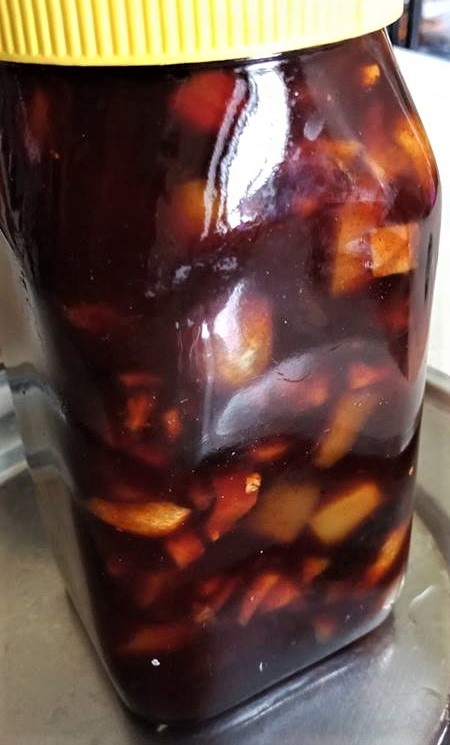
The dry fruit chutney recipe I am sharing here is the family recipe of one of my close school friends. Friendships may last or not last, but, this recipe has stayed with me till date. The sweet, sour and tangy taste lingers on reminding me of the sweet childhood days. This chutney has an awesome and unique taste due to the ingredients and is quite easy to make and you are sure to love it. It tastes good with almost anything.

Ingredients
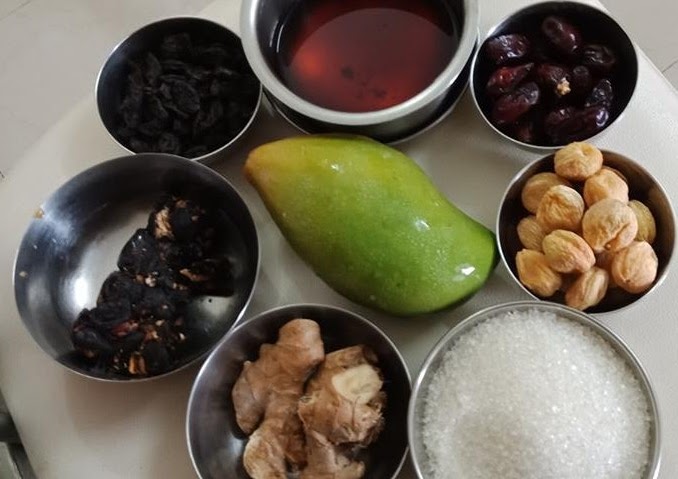
Raw Mango – ½ kg
Dates – 125 gm
Dried Apricots – 250 gm
Black Currants – 125 gm
Big Currants – 125 gm
Tamarind – 125 gm
Ginger – 100 gm
Sugar – 750 gm
Brown Vinegar – 250 ml
Water – 350- 400 ml
Red Chilli Powder – As per taste

Method
The raw mango murabba (jam) needs to be prepared a day ahead. For the raw mango murabba, skin the mango and cut in cubes. Pressure cook the raw mango in a covered utensil for about 10-12 minutes. Mix sugar and 250 ml water and bring to boil and add the cooked mango and cook for 8-10 minutes. Allow to cool, cover and store aside.
Wash and clean all the dry fruits well. Remove seeds from the dates, apricots and black and big currants. Chop dates and apricots in small pieces. Soak tamarind in water for an hour and strain the pulp and keep aside. Remove the skin from ginger and chop it into small pieces.
Add vinegar, tamarind pulp, chopped ginger, red chilli powder to the raw mango murabba and boil for about 10 -12 minutes. Finally, add all the cleaned dry fruits to this boiling mixture and bring to boil once and remove from fire. Allow to cool. Store in sterilised glass jars/bottles. Refrigerate if you plan to keep it for longer than a month.


Monday, July 9, 2018

MyMusingsSangSpeak- Pet Puja - Alu che Gargate (Alu chi Patal Bhaji/Alu che Phatphate)


Alu che Gargate (Alu chi Patal Bhaji/Alu che Phatphate)
Alu (Marathi word) is known as Colocasia/Arum in English and Arbi in Hindi and its tubers and leaves are used as vegetables in Indian cooking. This vegetable is full of vitamins and minerals and one must keep it in diet for these nutritious reasons.  The vegetable has the element called raphides (very fine needle like calcium oxalate crystals), that cause itching and discomfort. This acridity needs to be neutralised by using acidic material like tamarind, lime etc and proper cooking.
In Maharashtra, the Colocasia leaves are used to make Aluchi Wadi, a favourite Maharashtrian savoury snack and, in North India, it is known as Patra or Pattaud or Patraud. The tubers are prepared in a similar fashion as potatoes. Alu che gargate or Alu chi Patal Bhaji or Phatphate is a delicacy that is served during Maharashtrian weddings. It is an all-time favourite of Maharashtrians.
There are two types of edible Colocasia leaves in the market, one that is lighter green in colour and one that is dark green in colour. The lighter green is used to make the fluidy vegetable and the darker green variety is used to make the Wadi or the snack. In case, the light green variety is not available, one can substitute it by the dark green variety. The assembling takes a bit of time and cooking is quite easy.

Ingredients
Colocasia leaves with stems – 7-8 nos
Groundnuts – ½ - ¾ cup
Bengal Gram Daal – 2 tablespoons
White Radish – 3-inch piece
Fresh Coconut slices – 2 tablespoons
Tamarind – 2 tablespoons
Jaggery – 1½ tablespoons
Garlic – 10-12 cloves
Green Chillies – 2 – 3 nos
Turmeric – ½ teaspoon
Besan (Gram flour) – 3 tablespoons
Salt – As per taste
Oil/Ghee – 2 tablespoons
Mustard Seeds – ½ teaspoon
Water – Approx 5-6 cups

Method
Wash the Colocasia leaves and stems thoroughly, skin the stems and chop finely. Soak the groundnuts and daal for an hour. Soak tamarind also for an hour. Skin the radish and chop into cubes. Sieve the tamarind and extract the pulp. In a utensil, take the chopped Colocasia stem and leaves, along with soaked groundnuts, daal, jaggery, tamarind extract, turmeric, salt, chopped radish, and about 4-cups of water. Steam this in pressure cooker for about 20 minutes. Remove from pressure cooker, once the steam is let off, add the besan flour and give a nice stir with hand stirrer.
In a small vessel, heat oil and add mustard seeds, chopped green chillies and mustard seeds till they splutter. Add this tempering to the cooked vegetable and cook it for about 7-8 minutes. Serve hot with chapati or rice.

Note - Assembling time is about an hour and cooking tome 30-40 minutes. This quantity should be enough for 4 persons.


Tuesday, July 3, 2018

MyMusingsSangSpeak - My Kinda Photography


My Kinda Photography


With the advent of modern technology, photography has become the most sought-after hobby and profession. I got interested in photography in my teens and back then, it was more of black and white photography. Cameras were a costly affair and very few people could afford this luxury. There was maybe one camera per family on an average during my childhood. If you were going on a travel, mostly you would be borrowing a camera from your relative, either uncle or cousin.

Photographs are a sure shot way of capturing the momentous occasions of one’s life and preserving those memories forever. My first encounter with a camera was about 40 years ago when I went for a school trip to Kashmir and had borrowed my Uncle’s black and white 16 mm Yashica camera. As this was the first experience of handling a camera, the results were just about satisfactory. I hardly knew anything about photography and even today, I have not learnt much. As time passed, through the college years came the 28 mm Minolta, followed by the 36 mm Kodak, Konica and so on. We had to insert the camera roll and use autofocus to shoot. The photographs need to be processed in photo studios/labs to make prints. All this is bygone era now.

Now, fast forwarding to the electronic and digital age, ushered the era of digicams. My daughter, who is quite an expert in photography and also has done a course, introduced me to it and I slowly took to photography. My technophobia just does not allow me to try out the latest technology quickly. I began with the Sony Cybershot Digicam point and shoot camera about five years ago and just went on clicking spree. My daughter has given me lots of valuable tips and inputs about various aspects of photography, which have helped me greatly. She prods me to take a course and I am yet to take that piece of advice, maybe sometime soon. Till then, I am just a self-taught photographer.

Presently, I use Sony Cyber-shot DSC-H300 and it has given me good results. Nowadays, as mobile phones come with built in cameras, I use mobile cameras too, and have tried to click good snaps with LG Smartphone, Samsung Note 3 Neo that has given excellent results always and my latest is Oppo F5.  I am now waiting to graduate to using DSLR. I am asked always by my friends as to which camera I use to click photographs and I tell them that I use the one that is available to me. It is the standard answer that all expert photographers give, as told to me by my daughter also, time and again, all depends on the photographer to click a great picture.

This article was long overdue and is dedicated to all my friends who appreciate my photography and continually encourage me to excel. Photography is passion for me and I hope to continue it as long as it gives me happiness. Every photo has a story behind about it as to why, where, when and how. The wildlife and bird photographs take hours of waiting and patience, the efforts are paid off after seeing the results. I rarely edit my images, except for cropping. I don’t know much about the technicalities of photography, hope to learn soon. Thanks to you all for being a part of my photographic journey so far.