Monday, June 5, 2017

MyMusingsSangSpeak-Pet Puja - Methamba

Methamba
Methamba is a sweet sour and tangy accompaniment, something like a pickle, made of raw mango with the distinctive flavouring of fenugreek seeds, hence, the name MethaAmba (Fenugreek seeds+Raw Mango/Kairi/Aamba). This dish was always made by my mother quite often during the mango season and I just loved it. It is a quick to make simple recipe and serves as a delicious accompaniment to any meal.
Ingredients
Raw Mango – 1 medium sized
Jaggery – 2 tablespoons
Salt – As per atste
Red Chillies – 2-3 nos
Fenugreek Seeds – ¼ teaspoon
Coriander seeds – ¼ teaspoon
Mustard Seeds – ¼ teaspoon
Oil – 2 tablespoons
Asafoetida – A small pinch
Water – ¾ cup
Method
Peel the raw mango and cut in small pieces. Break jaggery in small pieces and dissolve in water. Heat oil, add asafoetida and fenugreek seeds, then add pieces of red chillies, mustard seeds and coriander seeds. Add mango pieces, salt and jaggery water. Cook for about 10 minutes, add more water if required.  Remove from fire, cool and serve as accompaniment with meals. This will stay for 2 days without refrigeration, and for about a week if refrigerated.

Note – I am giving recipes in smaller quantities as families are more or less nuclear nowadays. You may increase the quantity as per your requirements.

MyMusingsSangSpeak-Pet Puja - Kairi Pudina Chutney (Raw Mango Mint Chutney)

Kairi Pudina Chutney (Raw Mango Mint Chutney)
Kairi Pudina Chutney is a sour sweet accompaniment for summer meals and quite easy to make. It goes well with many fried snacks too. It is made of all fresh raw ingredients and acts as a coolant for harsh summers.
Ingredients
Raw Mango – 1 medium sized
Mint – 8- 10 sprigs
Jaggery- 2 tablespoons
Green Chilly – 1 medium
Garlic – 6-8 cloves
Salt – As per taste
Cumin Powder – ¼ teaspoon
Water – ¼ cup

Method
Peel and deseed the raw mango. Cut mango into small pieces. Break jaggery into small pieces. Mix all the ingredients together and grind to a fine paste. Add more water if required. Refrigerate the chutney. It stays refrigerated for about a week.

Wednesday, May 31, 2017

MyMusingsSangSpeak-Pet Puja - Kolhapuri Aamti

Kolhapuri Aamti
The Kolhapuri Aamti is a recipe which is very close to my heart and associated with childhood memories. I spent a good amount of my childhood in Kolhapur and every die-hard Kolhapuri can relate to fascination of this special recipe which is utmost basic and simple, yet, divinely tasty.
As Kolhapur is famous for wrestling, wrestlers and milk diet, there was no place for tea at all in the earlier days. If you happened to visit anybody’s house or vice versa, you would always be asked by the lady of the house “Khatos ka Baba thodasa Bhaat Samabara” (Will you eat some rice daal?). Daal and rice were always a staple here and readily available in every household and the taste of this awesome combination lingers on till date.
The Daal is made with Kolhapuri Kaala Masala which lends that unique flavour to it. The spiciness of the daal would be reduced by adding milk cream and you need to taste this combination of rice, daal and milk cream to experience this exceptional dish. Kolhapur area is famous for various strains of indigenous rice too, so, maybe the rice also added to that special taste.
I am giving the recipe of my version of Kolhapuri Aamti, it does not match the greatness of my grandmother’s recipe though; it was a class apart altogether.
Ingredients
Tur Daal/Arhar Daal/Pigeon Peas (split, without cover) – 1 large katori or you can take a combination of half of Tur/Arhar Daal and half of yellow moong daal (split green gram)
Water – Approximately 1 litre
Salt- As per taste
Turmeric Powder – Half taespoon
Cumin Powder- Half Teaspoon
Asafoetida – ¼ teaspoon
Oil- 2 tablespoons
Curry Leaves – 10-12
Mustard Seeds (Badi or Moti  Rai)– 1 teaspoon
Garlic – 10-12 cloves
Dry Coconut (grated) – 1 tablespoon
Kolhapuri Kaala Masala/Kanda Lasun Masala – 1½ teaspoon
Method
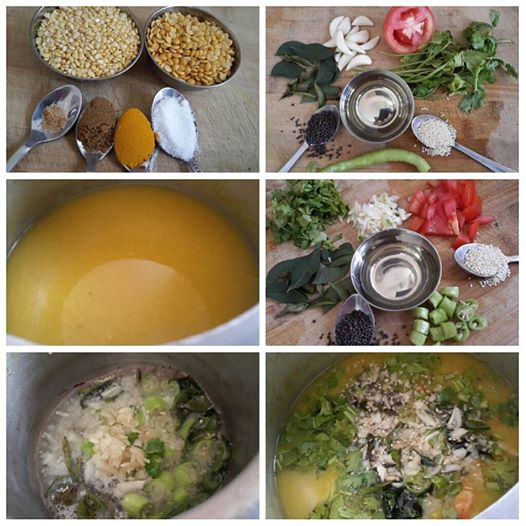
Wash the daal well and add water, turmeric powder, salt, cumin powder, asafoetida and cook in pressure cooker on medium flame till 3 whistles are done. Once, the pressure is released, churn the daal mixture well to form a homogenous mixture. For tempering, heat oil in a utensil, add mustard seeds, curry leaves, crushed garlic and dry coconut and Kolhapuri Kaala Masala. Remove from fire and transfer this tempering to the plain daal. Bring to a boil. Serve hot with roti or rice, topped with ghee.

Note – Cooking time is approximately 45 minutes and this quantity should be enough for 4/5 persons.

Daal (pulses) is the most essential component of Indian diet. Daal is significant source providing proteins and different parts of the country, varieties of various Daals are prepared in different ways. In Maharashtra, Tur Daal (Arhar Daal, Pigeon Pea) is used primarily for daily use. It can be made into a plain, bland recipe with turmeric, asafoetida and cumin or it can be tempered with different ingredients like curry leaves, garlic, garlic ginger, green chilly, red chilly, mustard seeds, coriander seeds, masalas, curry powders and one can add tomatoes, coriander leaves, jaggery etc to enhance the taste.
Phodni/Tadka means tempering and Waran is plain Daal, a basic bland recipe with just turmeric, salt, little cumin powder and asafoetida. 


Monday, May 29, 2017

MyMusingsSangSpeak-Pet Puja - Phodniche Waran (Tadkawali Arhar ki Daal)

Phodniche Waran (Tadkawali Arhar ki Daal)
Daal (pulse) is the most essential component of Indian diet. Daal is significant source providing proteins and in different parts of the country, varieties of various Daals are prepared in different ways. In Maharashtra, Tur Daal (Arhar Daal, Pigeon Pea) is used primarily for daily use. It can be made into a plain, bland recipe with turmeric, asafoetida and cumin or it can be tempered with different ingredients like curry leaves, garlic, garlic ginger, green chilly, red chilly, mustard seeds, coriander seeds, masalas, curry powders and one can add tomatoes, coriander leaves, jaggery etc to enhance the taste.
Phodni/Tadka means tempering and Waran is plain Daal, a basic bland recipe with just turmeric, salt, little cumin powder and asafoetida.
Ingredients
Tur Daal/Arhar Daal/Pigeon Peas (split, without cover) – 1 large katori or you can take a combination of half of Tur/Arhar Daal and half of yellow moong daal (split green gram)
Water – Approximately 1 litre
Salt- As per taste
Turmeric Powder – Half taespoon
Cumin Powder- Half Teaspoon
Asafoetida – ¼ teaspoon
Oil- 2 tablespoons
Curry Leaves – 10-12
Mustard Seeds (Badi or Moti  Rai)– 1 teaspoon
Til (Sesame seeds) – ½ teaspoon
Garlic – 10-12 cloves
Tomatoes- 1 medium sized
Coriander leaves – 2 tablespoons
Green Chilly – 1 large 

Method
Wash the daal well and add water, turmeric powder, salt, cumin powder, asafoetida and cook in pressure cooker on medium flame till 3 whistles are done. Once, the pressure is released, churn the daal mixture well to form a homogenous mixture. For tempering, heat oil in a utensil, add mustard seeds, curry leaves, chopped green chilly, crushed garlic and sesame seeds. Remove from fire and transfer this tempering to the plain daal. Add chopped tomatoes and coriander leaves and bring to a boil. Serve hot with roti or rice, topped with ghee.

Note – Cooking time is approximately 45 minutes and this quantity should be enough for 4 persons.

In Maharashtra, there is another variation of this recipe and that is the Aambat God Phodniche Waran (Sweet Sour Tempered daal), wherein Kokum (Mangosteen/Garcinia indica) and Jaggery are added for sweet sour flavouring.

MyMusingsSangSpeak-Pet Puja - Aambyache (Kairiche) Jhatpat Lonche (Instant Raw Mango Pickle), Karam

Aambyache (Kairiche) Jhatpat Lonche (Instant Raw Mango Pickle), Karam
The Indian summers can be fully associated with the mango season. Hundreds of varieties of mangoes are available across the length and breadth of the country and are used in different forms like pickles, juices, squashes, desserts, dried powders and so much and so on. I am in love with mangoes and my love affair with them is eternal kinds, I love mango in all forms. This instant raw mango pickle is traditionally served in the Maharashtrian marriage thali (plate) as most of the Maharashtrian marriages are solemnised in peak summers when raw mangoes are readily available aplenty.
This instant raw mango pickle is also called Karam and is a simple recipe and finger-licking good too. It reminds me of the carefree childhood days full of fun and frolic.
Ingredients
1 medium sized raw mango, half teaspoon salt, half teaspoon red chilly powder, 2-3 teaspoon sugar, 1/4th teaspoon turmeric, 2 teaspoon oil, half teaspoon mustard seeds, a pinch of asafoetida.

Method
Cut mango in small pieces, add salt, chilly and turmeric powder, sugar and set aside for an hour. You may remove the skin of the mango or retain it as per your liking. Heat oil and add asafoetida and mustard seeds, let the seeds splutter, remove from fire, allow to cool and add to the above mixture. If you like it more salty and spicy, then add more salt and chilly powder. You can use jaggery in place of sugar.


Note - This pickle stays in the fridge for about 4-5 days. Try and make in small quantities to consume fresh.

Friday, April 14, 2017

MyMusingsSangSpeak-Pet Puja- Brownie Cake

Brownie
Brownies are those dark chocolicious treats that anyone can hardly resist. Brownie is an easy recipe, quite like the plain cake one. I have baked this brownie in a pressure cooker, it can be baked in electric oven or cuisinette and timings adjusted accordingly. As far as the fat is concerned, you can use salted/unsalted butter or milk cream. If you use unsalted butter or cream, then you need to add a pinch of salt.
Ingredients
Flour – 100 gms
Sugar – 120 gms
Milk cream – 100 gms
Eggs – 2 nos
Cocoa Powder – 3 tablespoons
Milk – ½ cup
Walnuts – 100 gms
Baking Powder – ¾ teaspoon
Salt – A large pinch


Method
Sieve together flour, baking powder and salt and set aside. Break half of the walnuts into small pieces and keep the rest as whole for decoration on the top of the cake. Mix milk cream and cocoa powder by beating well and melting lightly on a medium flame. Remove from the flame and add sugar, beat well. Add both the eggs and beat well. Add the sieved flour gradually and fold in well. Add the broken walnut pieces and milk and mix well. Pour into a butter and flour lined baking tray. Place in pre-heated pressure cooker with a separator. No whistle is to be placed. I use old rubber gasket for the lid. You may or may not use the rubber gasket for the lid. Bake for 30 minutes, do the knife or tooth pick taste (insert in the centre to check if cake is fully baked, if the knife/tooth pick comes out clean, it means cake is baked fully)
Note – The cake can be baked in an electric oven that is preheated at 180 degrees Centigrade for half hour. 


MyMusingsSangSpeak-Pet Puja - Mulyachi Bhaji( Mooli ki Subji, White Radish Vegetable)

Mulyachi Bhaji(Radish Subji)
Radish is primarily used as salad along with carrot, mostly in northern parts of India. It is also used to make Paranthas, Subjis, Pickles, and Daals and used in combination with meat mostly in Himachali and Kashmiri Cuisines. Mostly people do not enjoy this strong smelling vegetable, and, even I did not enjoy it much during childhood. I like the way it was cooked as a vegetable by my grandmother and mother. It is a simple and quick recipe and tastes good too. For this recipe, you will require tender radish with fresh green leaves.

Ingredients
Radish (white) - One medium sized with fresh green leaves
Onion - One medium sized
Garlic - 10-12 cloves
Green Chilly - 1-2
Oil – 2 tablespoons
Salt – As per taste
Cumin – ¼ teaspoon
Carom seeds – ¼ teaspoon

Method
Wash radish well, remove peel and chop leaves and radish finely. Chop onion and crush garlic and chilly. Heat oil in a pan, add cumin and carom seeds. Add onion and let it caramelise. Add crushed garlic and chilly and, then add chopped radish and leaves. Add salt, stir well, cover with a lid and let it cook for 2-3 minutes on medium flame. Sprinkle little water if required, otherwise it will cook in its own juices.
This subji tastes good with bhakri (sorghum roti/bread), chapatti or as a side dish with daal-rice.